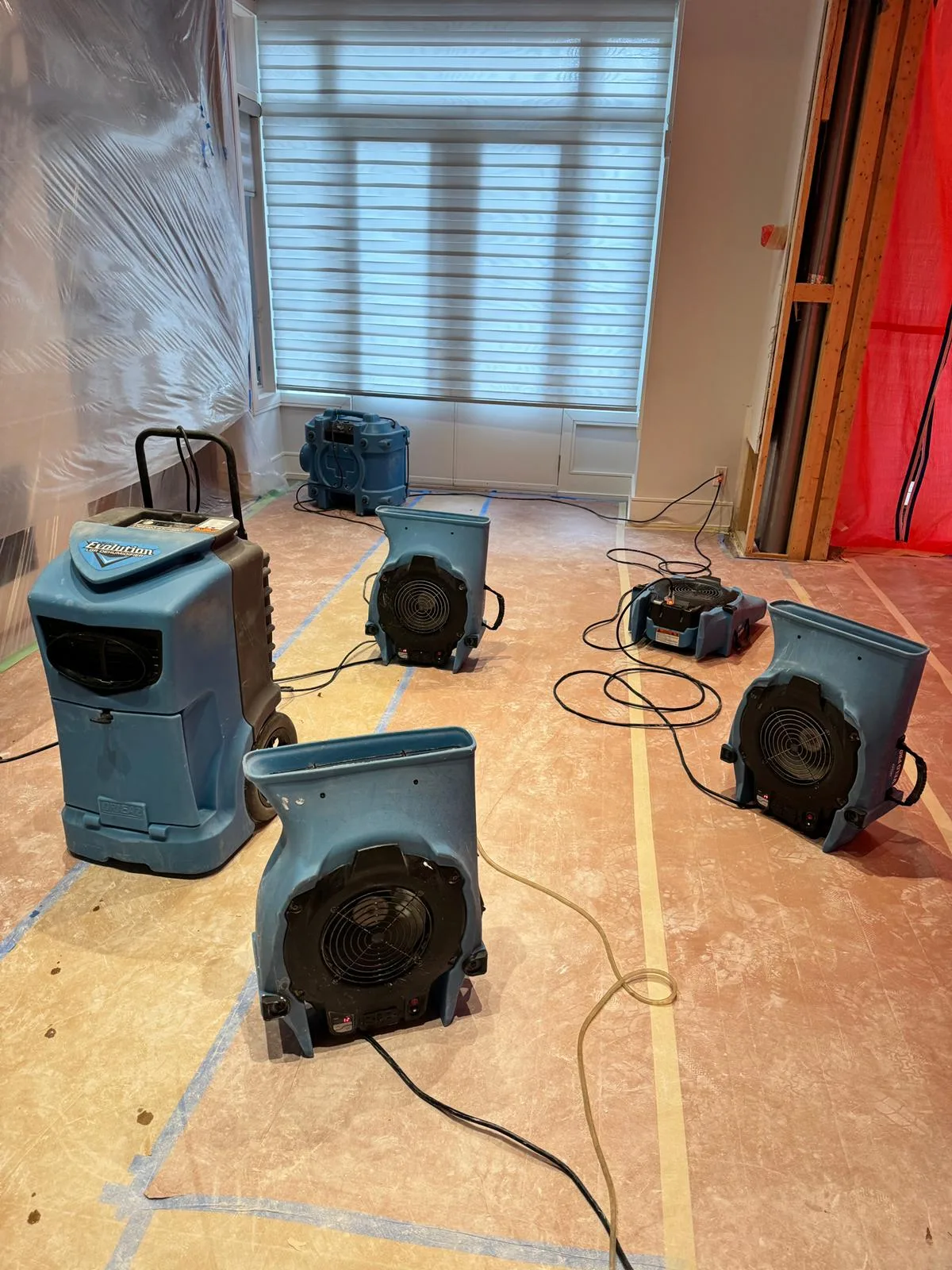
Structural Drying in Toronto & the GTA
Structural drying is the process of removing bound moisture from building materials — wood framing, subfloor, drywall, insulation, concrete — after a water loss. It requires commercial-grade LGR dehumidifiers, axial air movers, daily moisture monitoring, and calculation of the right drying environment for the specific materials affected. Done right per IICRC S500, most structures dry in 3-5 days with daily verification.
What Proper Structural Drying Actually Is
Structural drying is applied psychrometrics — the science of controlling temperature, humidity, and air movement to pull moisture out of building materials faster than the materials can absorb it back. The equipment matters, but so does the calculation behind where the equipment goes and what settings it runs at. This is why drying times vary so widely between professional jobs and DIY attempts with rented fans. Health Canada's mould guidance notes that mould begins colonizing wet building materials within 24-48 hours — the entire purpose of professional drying is to beat that clock.
The goal is simple: reduce the moisture content of every affected material to its dry standard, then stop — because over-drying causes its own problems (wood cracking, drywall shrinkage). The method is equally simple in concept: dehumidifiers pull moisture out of the air, air movers keep the moisture evaporating off surfaces, and daily moisture meter readings verify you are actually making progress.
The Equipment We Use
- LGR (Low Grain Refrigerant) Dehumidifiers — commercial units that pull 20-30 gallons of water per day from the air. The "LGR" matters: standard refrigerant dehumidifiers stop working effectively below about 60% relative humidity, while LGR units keep pulling moisture down to 35% RH.
- Desiccant Dehumidifiers — used for large-volume drying, cold environments, or when very low humidity is needed. These use silica desiccant wheels and work in temperatures where refrigerant units can't.
- Axial Air Movers — high-velocity, low-profile fans that accelerate evaporation from wet surfaces. Placed at 15-20 degree angles to walls and floors for optimal airflow patterns.
- Centrifugal Air Movers — deeper air penetration for drying inside cavities and under flooring assemblies
- Hardwood Drying Mats / Injectidry Systems — specialized panels that draw moisture through the face of hardwood floors under negative pressure. Saves wood floors that would otherwise cup and require replacement.
- Wall Cavity Drying Systems — small-diameter injection nozzles that push dry air into wall cavities through unobtrusive holes, drying insulation without wholesale drywall removal
- Moisture Meters — pin-type for wood, pinless for concrete and drywall, thermal cameras for hidden wet areas
Our Drying Process
Initial Moisture Mapping
Before any drying equipment is set, we map every wet material and record baseline moisture readings at marked locations. Thermal imaging identifies hidden moisture in walls, ceilings, and subfloor. Those baseline readings become the reference for every daily check that follows.
Equipment Calculation & Placement
Based on the affected square footage, material types, and environmental conditions, we calculate the number of dehumidifiers, air movers, and containment needed. Equipment is placed to create continuous airflow across wet surfaces without short-circuiting.
Containment Setup
For larger losses we build poly containment around the drying zone to isolate the dehumidifier work area from the rest of the home. This speeds drying and prevents conditioned air from unaffected areas from slowing the process.
Daily Monitoring & Equipment Adjustment
Every day our technician returns to check moisture readings at every reference point, log environmental conditions (temperature and humidity inside and outside containment), and adjust equipment placement as materials dry at different rates.
Dry Standard Verification & Demobilization
When all materials meet their dry standard (verified by two consecutive daily readings), we demobilize equipment and provide a complete moisture log. That log becomes part of your insurance documentation and certifies the property as dry.
Why Drying Fails When Done Wrong
Drying failures usually trace back to three mistakes:
- Under-equipped jobs — too few dehumidifiers for the volume being dried, so the air stays saturated and evaporation stalls
- No daily monitoring — equipment gets placed on day one and not touched again, so the drying schedule is a guess instead of a measurement
- Hidden wet areas missed — moisture inside walls or under hardwood that was not identified during initial mapping, so it never gets properly dried and becomes the source of mold growth later
This is why structural drying matters as a distinct service. Plumbing companies and general contractors often extract water and walk away, assuming the homeowner will "let it dry." That assumption is how basements end up with mold three weeks after a flood that was supposedly handled — and how insurers end up disputing the claim later. The Insurance Bureau of Canada is explicit that gradual or unaddressed moisture damage is generally excluded from coverage, which is why proper documented drying with daily moisture logs matters for the claim, not just the building.
Per IICRC S500, structural drying with daily verification is not optional on a water loss — it is the difference between "cleaned up" and actually restored. Drying is the second half of every water damage restoration and every emergency water response we run.
Structural Drying Emergency?
Available 24/7 across the GTA
Why homeowners across the GTA call us first.
24/7 emergency response
A real technician answers the phone — not an answering service. Trucks roll within five minutes of your call.
IICRC certified, Baeumler approved
Every job follows IICRC S500/S520 protocols, so your insurance claim is documented to the standard adjusters expect.
Insurance handled directly
We bill your insurer, document the scope, and stay in front of the adjuster. You pay the deductible.
In-house from start to finish
Same crew from the first emergency call to final paint. No subcontractors, no handoffs, no finger-pointing.
Frequently Asked Questions
Wet Structure? The Meters Decide — Not the Schedule.
Commercial drying equipment and daily moisture verification. Free on-site assessment across the GTA.