Serving Toronto · IICRC Certified
Mold Testing in Toronto
Mold testing in Toronto involves air sampling, surface sampling, or both, with lab analysis from an accredited AIHA facility. Testing is worth the money in specific situations — hidden contamination, sensitive occupants, real estate transactions for older Toronto houses, disputes, and post-remediation clearance — but it does not replace visual inspection, and it rarely changes the remediation protocol when visible mold is already present.
Dispatched from 85 Ellesmere Rd in Scarborough — 25-70 minute response across Toronto for sample collection.
Why Toronto Homes Get Tested More Than Average
Toronto has a higher-than-average rate of mold testing compared to newer suburbs, and the reason is the housing stock. Pre-1950 housing — dominant across old Toronto, East York, the East End, West End, and downtown — has a complicated moisture history. Homes that are 80-140 years old have flooded, leaked, and been patched many times. New owners walk into a basement with a musty smell and no visible source, or occupants develop symptoms that might or might not be related to the home.
In those situations, testing answers a question that visual inspection cannot: is there hidden contamination at levels high enough to affect indoor air quality? Sometimes the answer is no, and the homeowner moves on. Sometimes the answer is yes, and it points to where to look for the source.
When Testing Is Worth It in Toronto
- Pre-purchase investigation on older Toronto houses — especially homes with known flooding history, a musty-smelling basement, or occupant reports of respiratory symptoms
- Hidden contamination suspected — occupants have symptoms, visual inspection is inconclusive, and you need quantitative data to scope the next step
- Sensitive occupants — asthma, COPD, immune compromise, or a medical diagnosis of mold sensitivity
- Post-remediation clearance after larger jobs — independent third-party verification that the remediation restored normal conditions
- Landlord-tenant or seller-buyer disputes — neutral, documented analysis from an accredited lab
- Insurance denials — baseline documentation when an insurer disputes the presence or extent of mold damage
- Condo building-level investigations — establishing whether a suite problem is from the unit or from shared building systems
Types of Samples We Collect
Air Samples (Spore Traps)
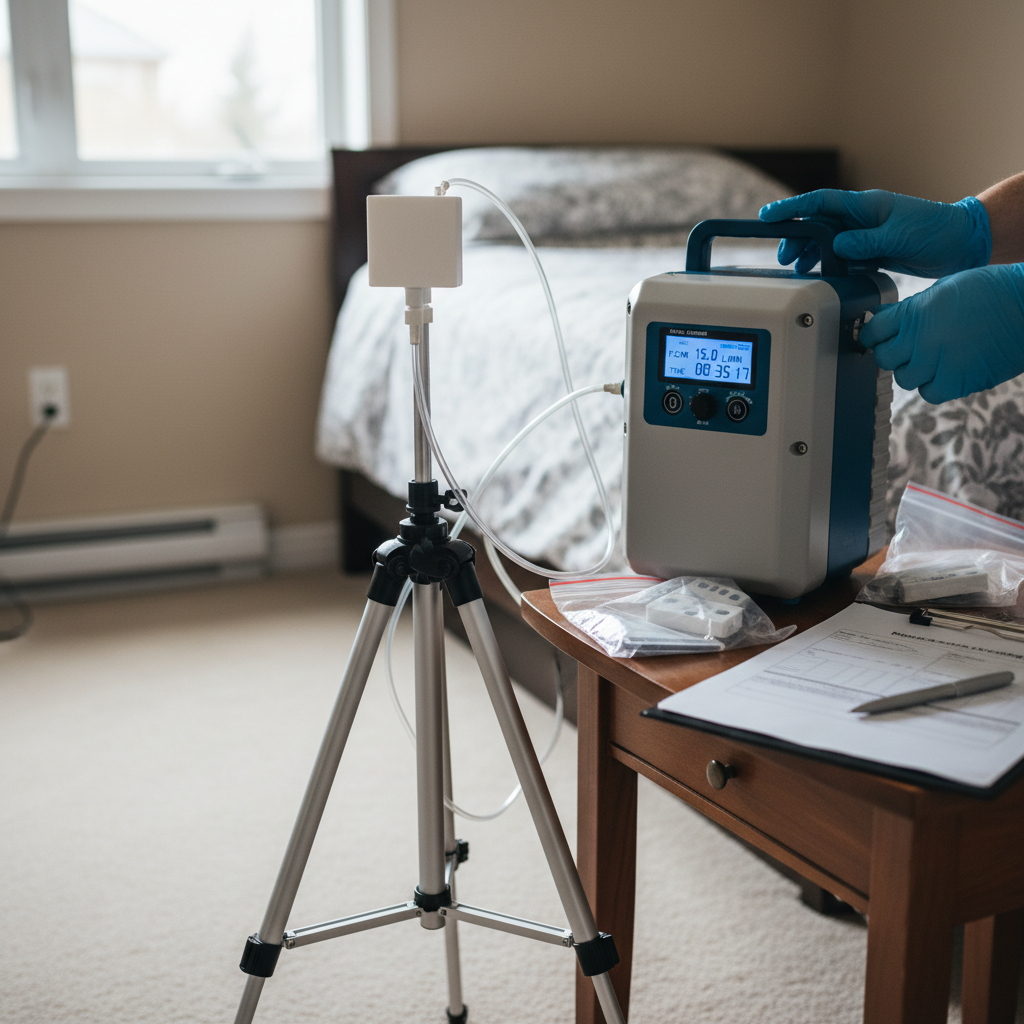
Calibrated air pumps pull a known volume over 5-10 minutes. Results are reported as spores per cubic meter by genus. Indoor samples always compare against a same-day outdoor baseline because outdoor spore counts vary dramatically by season, weather, and time of day.
Surface Samples (Tape Lifts)
Used to identify the exact species present on a visible surface. Particularly useful for distinguishing Stachybotrys from common Cladosporium or Aspergillus when species matters for medical or legal purposes.
Bulk Samples
Physical pieces of contaminated material sent to the lab for microscopic and culture analysis. Used when species identification is needed from a specific construction material — drywall, insulation, carpet, wood.
ERMI / HERTSMI-2 DNA Testing
PCR-based dust analysis identifying dozens of mold species from a single settled-dust sample. Primarily used in medical cases (CIRS, biotoxin diagnosis) where comprehensive species characterization is needed. Turnaround 7-10 business days.
How We Interpret the Results
The raw lab numbers mean nothing without context. What matters:
- Indoor vs. outdoor ratios — indoor counts similar to or lower than outdoor usually mean no indoor source
- Species profile — indoor species matching outdoor suggests tracked-in spores; indoor species different from outdoor (especially Stachybotrys, Chaetomium, high Aspergillus/Penicillium) suggests indoor amplification
- Location of sampling — a high count in a closed basement room with moisture is different from a high count in an open kitchen
- Symptomology — occupant symptoms that correlate with time in specific rooms matter for interpretation
We walk through the report with you in plain language. Health Canada does not publish specific spore-count thresholds for residential settings because context matters too much for single numbers to be meaningful. The interpretation is always "compared to what?" — outdoor baseline, other rooms, unaffected homes — not an absolute threshold.
Serving Toronto & Surrounding Areas
Based at 85 Ellesmere Rd, Scarborough — 24/7 response across the GTA.
Mold Testing Emergency in Toronto?
Available 24/7 — on-site within 45 minutes.
Other Restoration Services in Toronto
Mold Testing in Other GTA Locations
FAQ
Mold Testing in Toronto — FAQ
Need Lab-Documented Mold Analysis?
Accredited AIHA lab, 3-5 day turnaround, professional interpretation. Free in-home consultation.